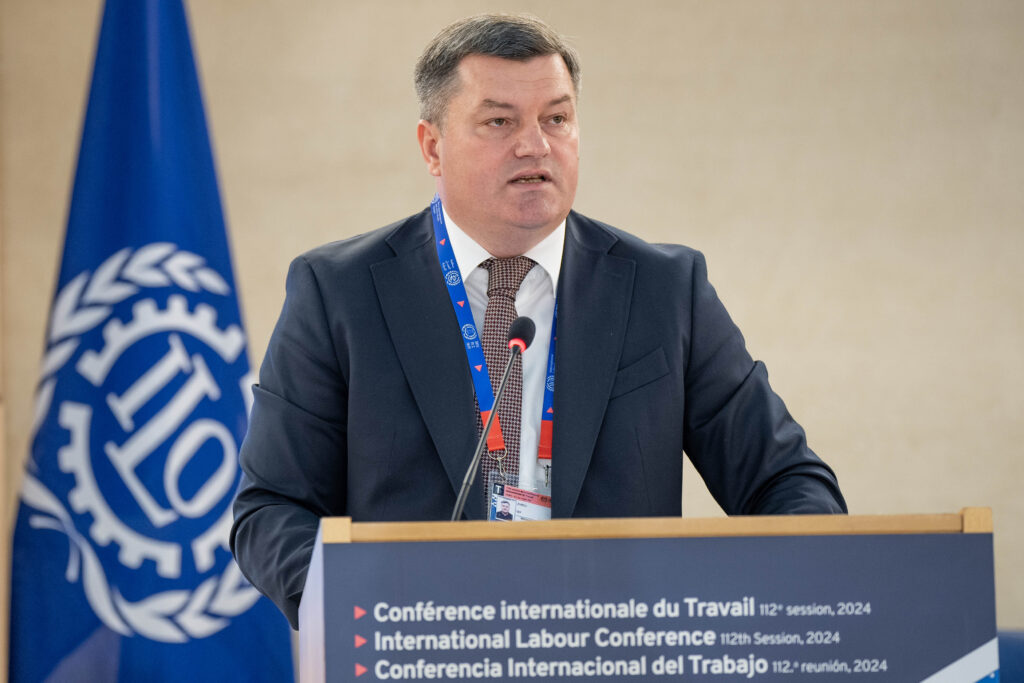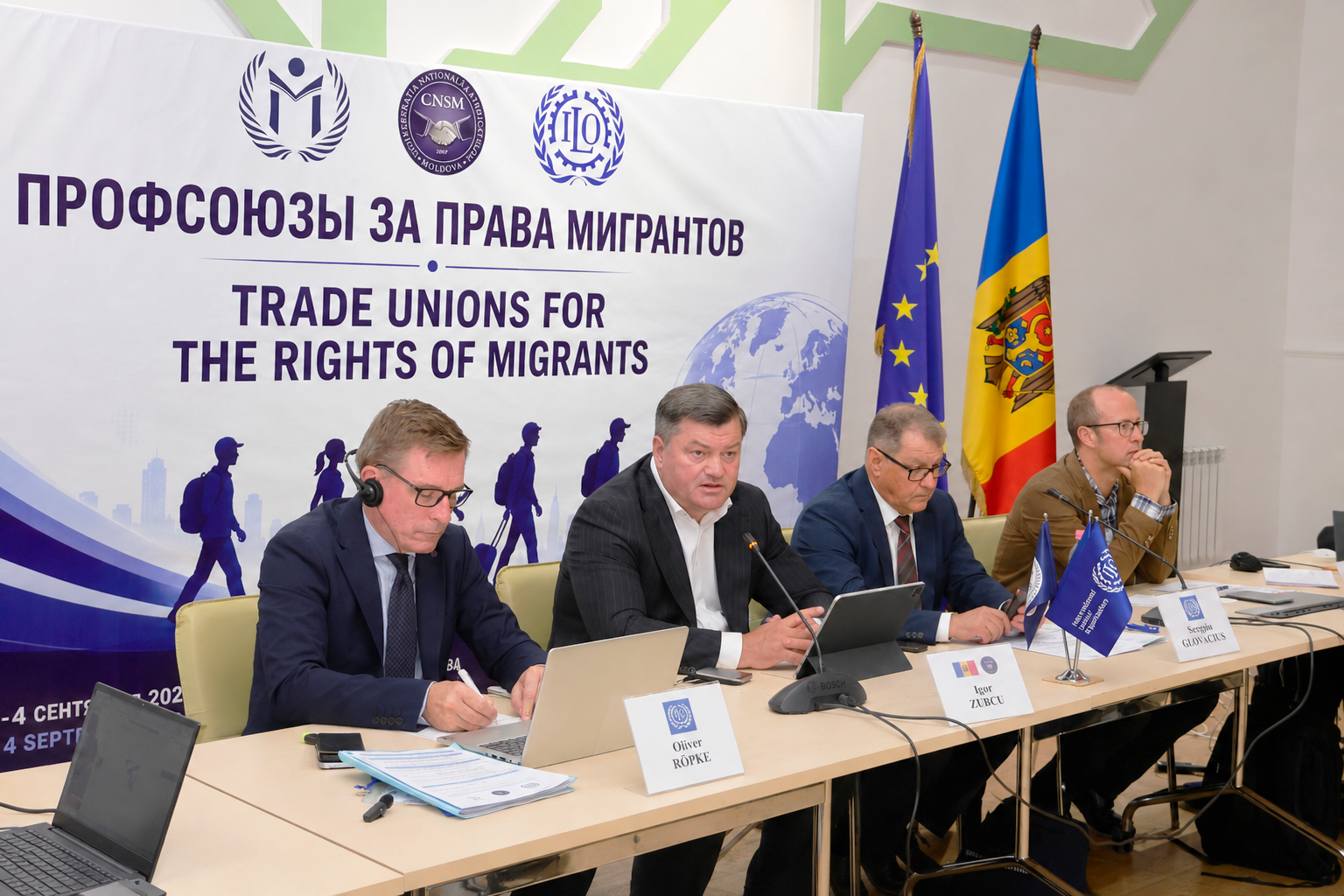
The protection of migrant workers’ rights and the strengthening of regional trade union cooperation were at the heart of the Regional Meeting for Eastern European and Central Asian Countries, held under the theme “Trade Unions for Migrants’ Rights” on 3–4 September 2026 at the Institute of Labour.
Organized by the International Labour Organization (ILO), in cooperation with the National Confederation of Trade Unions of Moldova (CNSM) and the Institute of Labour, the event brought together representatives of trade union organizations from nine countries. Participants discussed the challenges of labour migration, the protection of migrant workers, and the role of Migrant Resource Centres (MRCs) in providing support and assistance to them.
The opening ceremony was attended by Igor Zubcu, President of CNSM and President of PERC; Oliver Röpke, Director of the ILO Bureau for Workers’ Activities (ACTRAV); and Anton Leppik, Executive Secretary of PERC. The session was moderated by Sergeyus Glovackas, Desk Officer for Central and Eastern Europe at ILO-ACTRAV.
In his welcome address, Igor Zubcu, President of CNSM, noted that protecting rights and ensuring decent work for migrant workers must be an important priority of social policies and social dialogue. He stressed that the trade union movement has a responsibility to defend the rights, dignity and social justice of all workers, regardless of their citizenship, country of origin or migration status.
The CNSM President also called for closer cooperation between trade union organizations in countries of origin and destination, based on the exchange of information and experience, mutual support, and ensuring continuity in the protection of workers throughout the entire migration process.
For his part, Oliver Röpke emphasized that protecting migrant workers is a fundamental responsibility of the trade union movement. Respect for their rights contributes not only to safeguarding wages and working conditions, but also to strengthening solidarity among all workers.
In this context, the Director of ILO-ACTRAV highlighted the importance of Migrant Resource Centres, which can provide information, counselling, support and representation, while also facilitating workers’ access to protection mechanisms and trade union organizations. He also called for enhanced regional cooperation so that workers are protected regardless of the country in which they are recruited, work or return to.
The meeting provided a platform for dialogue and the exchange of experience on the protection of migrant workers’ rights, the development of trade union cooperation, and the strengthening of support mechanisms for people in vulnerable situations.
Over the course of the two-day meeting, participants addressed the experience and prospects for the development of Migrant Resource Centres, trends and challenges related to labour migration in Eastern Europe and Central Asia, international standards applicable to migrant workers, and opportunities to strengthen regional trade union cooperation. The meeting’s agenda also included mapping migration corridors, developing a regional work plan, and adopting final recommendations.
The discussions also highlighted the fact that labour migration has a significant impact on both countries of origin and destination. For the Republic of Moldova, this phenomenon represents both a social and economic challenge and a continuously evolving reality, with the country gradually becoming not only a country of origin for migrants, but also a country attracting workers from other states.
The Regional Meeting in Chisinau therefore aimed to contribute to strengthening dialogue and trade union solidarity in the region, as well as to identifying common solutions for more effective protection of the rights of migrant workers and people in vulnerable situations.
Globally, migration continues to be significant in scale. According to the latest estimates, there were approximately 304 million international migrants in 2024, while the International Labour Organization estimates that 167.7 million people were participating in the labour force of destination countries in 2022, representing 4.7% of the global labour force.
These figures highlight the important contribution of migrant workers to economies and labour markets around the world, while also underscoring the need to strengthen mechanisms for protecting their rights.