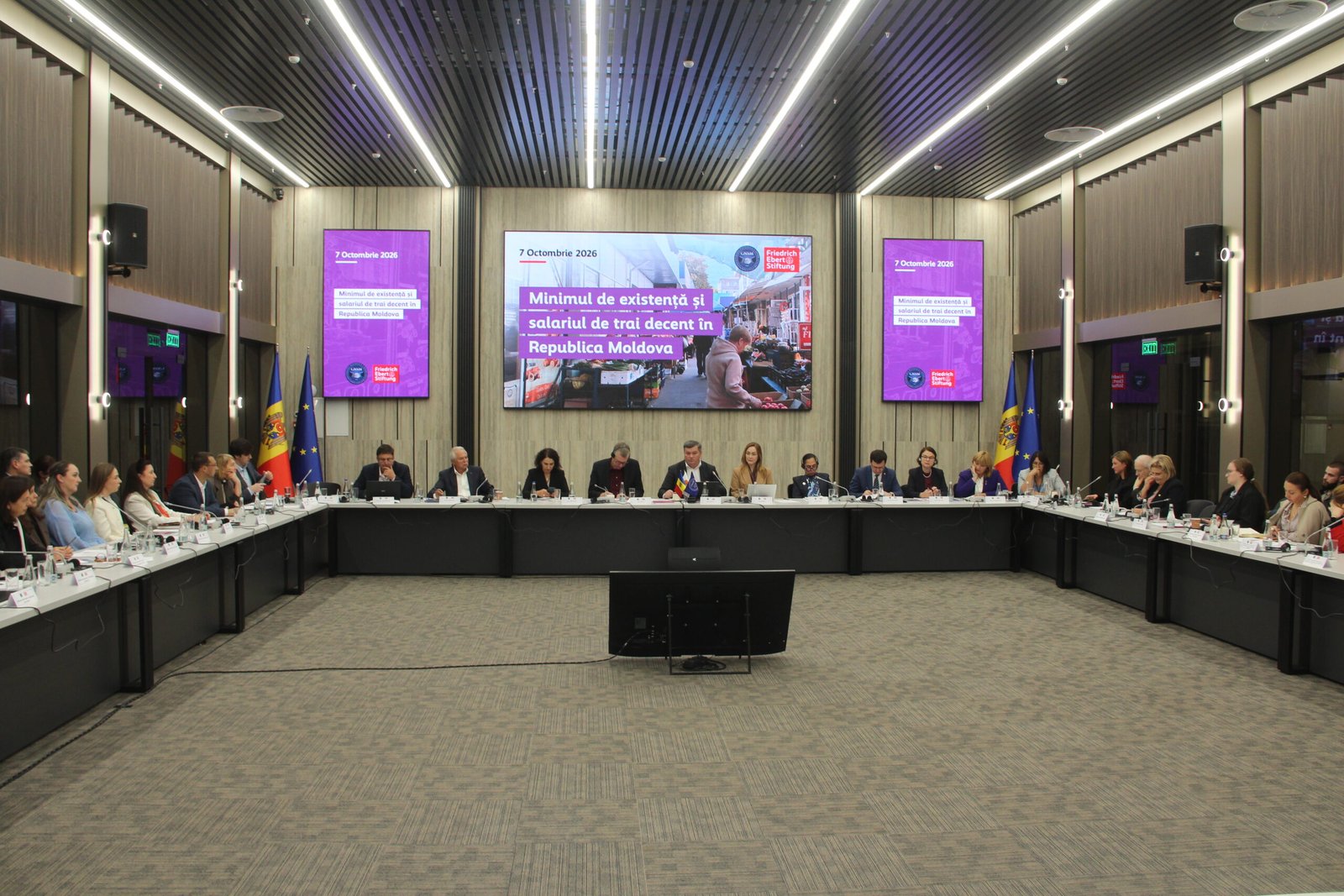
On the occasion of World Day for Decent Work, observed worldwide every year on 7 October, the National Trade Union Confederation of Moldova (CNSM) and the Friedrich Ebert Foundation (FES) Moldova organised a roundtable in Chișinău entitled “From Minimum Subsistence to a Decent Standard of Living: Wages, Dignity and European Social Convergence”.
The event brought together representatives of trade unions, public authorities, employers’ organisations, international organisations and the expert community, as well as Members of Parliament and representatives of non-parliamentary political parties. Discussions focused on the need to revise the Republic of Moldova’s wage and social policies so that people’s incomes reflect the real cost of living and ensure a decent and equitable standard of living.
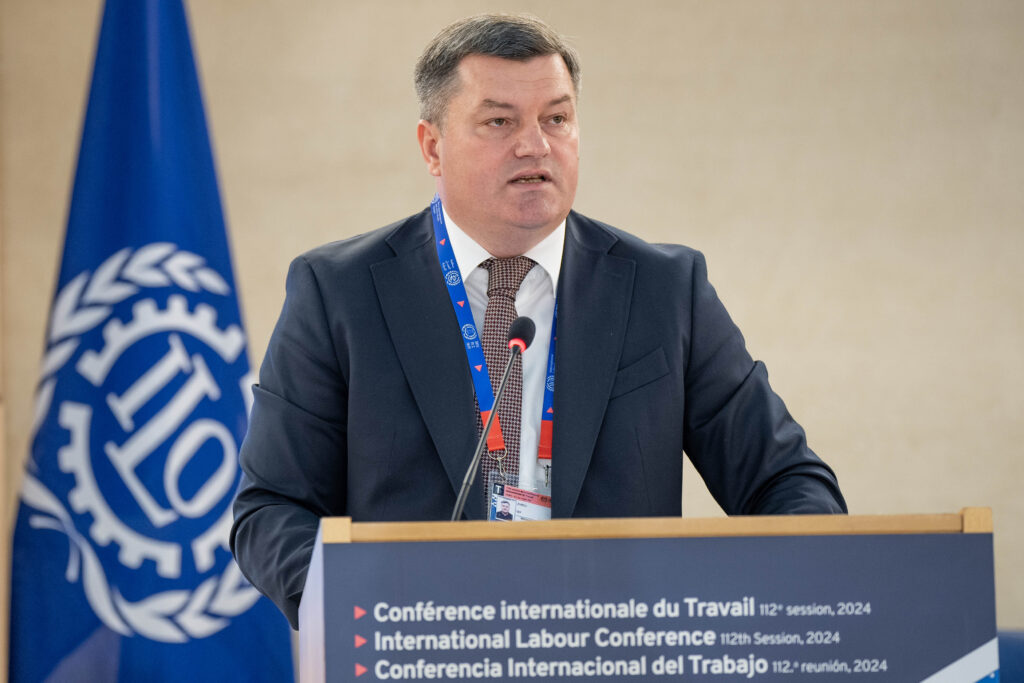
During the event, CNSM President Igor Zubcu emphasised that World Day for Decent Work is an opportunity for reflection and, at the same time, a reaffirmation of the trade union movement’s commitment to dignity at work, social justice and fair incomes.
Igor Zubcu noted that this year’s message proposed by the International Trade Union Confederation (ITUC), “Young Workers Organise for the Future”, draws attention to the challenges faced by young people in the labour market. In his view, one of the most significant problems is the gap between wage levels and the real cost of living, particularly in the case of entry-level salaries.
The CNSM President highlighted that insufficient incomes make it difficult for young people to achieve financial independence, start a family and build a professional future in the Republic of Moldova. At the same time, low wages can contribute to labour migration, including the migration of highly qualified workers, towards labour markets offering more attractive incomes and career prospects. In this context, Igor Zubcu stressed the importance of wage policies that ensure fair incomes and decent working conditions, giving young people genuine opportunities and reasons to build their future at home.
One of the main topics discussed at the event was the presentation of the study “Minimum Subsistence and a Living Wage in the Republic of Moldova”, prepared at the initiative of CNSM and the Friedrich Ebert Foundation (FES) Moldova. The study highlights the need to revise the current methodology for calculating the minimum subsistence level, which has not undergone substantial revision since 2013 and no longer fully reflects changes in consumption patterns, price levels, housing conditions and people’s access to goods and services.
In his remarks, CNSM President Igor Zubcu stressed that revising this indicator has been a longstanding priority for the trade union movement. He recalled that, following persistent trade union advocacy, the Law on the Minimum Subsistence Level was drafted and adopted in 2012, and the legal framework provided for the methodology to be updated at least once every five years. Despite this provision, the revision has not been carried out, although CNSM has repeatedly called for the methodology to be updated.
“The calculated minimum subsistence level must serve as a mandatory minimum social benchmark for determining all payments and benefits in the country,” Igor Zubcu stated, emphasising the need for a methodology based on clear, predictable and scientifically grounded data and standards.
For his part, Felix Hett, representative of the Friedrich Ebert Foundation in Ukraine and Moldova, emphasised that the study reflects the scale of the challenges facing the Republic of Moldova in terms of living standards and wage policies.
Felix Hett also highlighted the importance of the study’s findings for the debate on the Republic of Moldova’s development model and the country’s European path.
In this context, the study proposes a shift towards the concept of a “socially oriented minimum subsistence level”, based on a normative basket that explicitly assesses not only food products but also non-food goods and services necessary to meet basic needs and ensure a minimum level of social participation.
The study “Minimum Subsistence and a Living Wage in the Republic of Moldova” is available here: https://sindicate.md/studiu-minimul-de-existenta-si-salariul-de-trai-decent-in-republica-moldova/
The event also addressed the main challenges associated with ensuring a decent standard of living in the Republic of Moldova, including the gap between the real cost of living and people’s incomes, as well as ways to reduce this gap through sustainable wage, social and economic policies. Discussions also focused on the responsibilities of the state, employers and social partners in ensuring adequate incomes and decent working conditions.
An important part of the discussions was devoted to the relationship between the minimum wage and the Republic of Moldova’s European integration process. Participants discussed the social and wage standards the country should pursue on its path towards European Union membership, the need to bring workers’ incomes closer to the cost of a decent standard of living, and the role of social dialogue, collective bargaining and trade unions in translating this objective into appropriate wage policies.
The event concluded with a concrete step by the social partners: the signing of a Bipartite Collective Agreement at national level establishing a new minimum wage for the real sector of the national economy, effective 1 January 2027. Further details are available here: https://sindicate.md/2026/10/07/cnsm-si-cnpm-au-convenit-asupra-unui-salariu-minim-de-7-600-de-lei-pentru-sectorul-real-incepand-cu-1-ianuarie-2027/
World Day for Decent Work is observed annually on 7 October at the initiative of the International Trade Union Confederation (ITUC). It serves as a global mobilisation of trade unions to promote decent work and workers’ rights.
The video recording of the roundtable is available on CNSM’s Facebook page or on the Privesc.eu platform: https://www.privesc.eu/arhiva/112324/Masa-rotunda-dedicata-Zilei-Mondiale-pentru-Munca-Decenta–De-la-minimul-de-existenta-la-un-trai-decent–salarii–demnitate-si-convergenta-sociala-eur