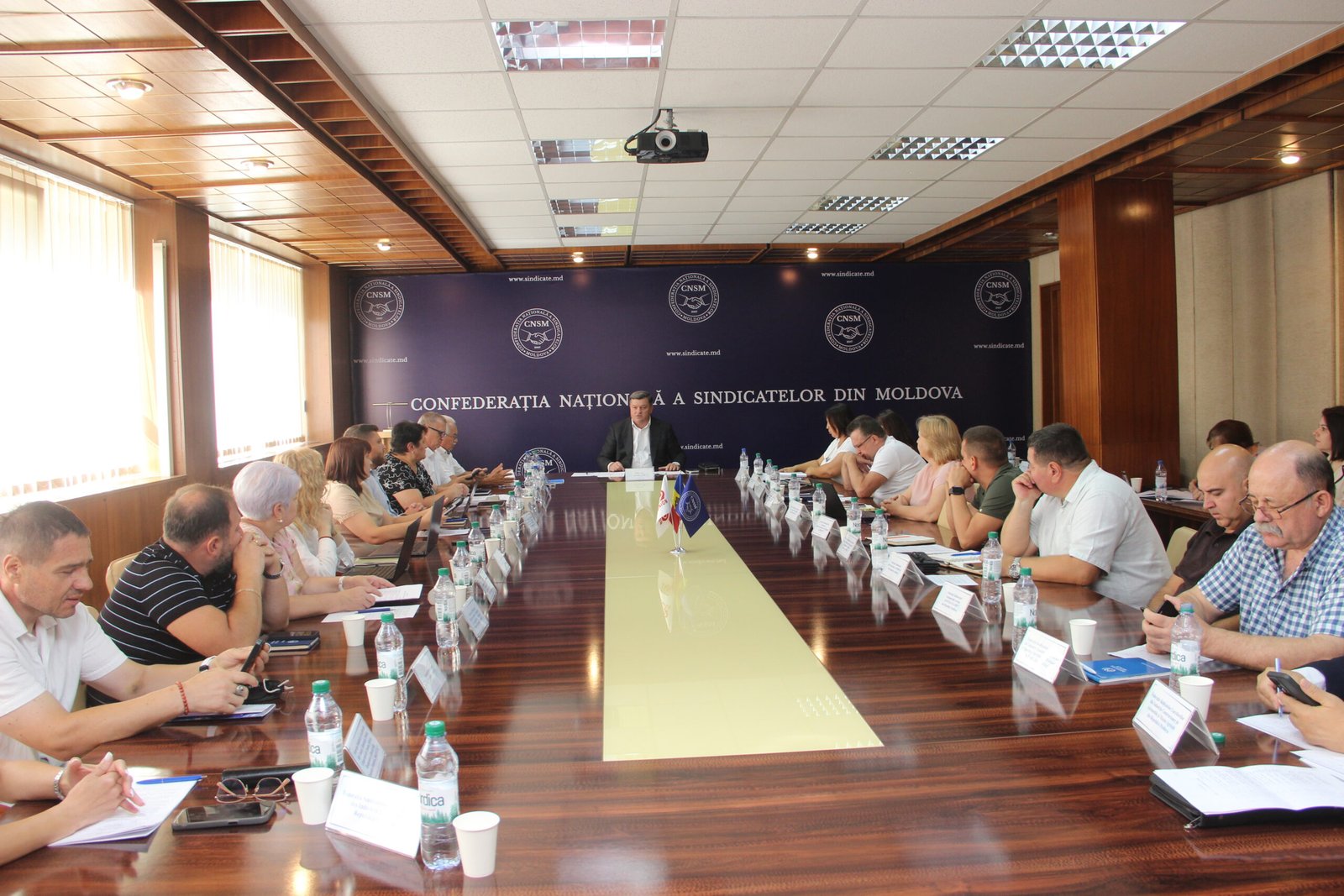
The National Trade Union Confederation of Moldova (CNSM) held a meeting of its Confederal Committee on Thursday, 20 August 2026, during which a number of important issues were examined, focusing on strengthening the rights of workers and trade union members, occupational safety and health, income protection, social dialogue, youth involvement in the development of the trade union movement, etc.
One of the main topics concerned the CNSM proposals for amendments and additions to the Labour Code. The proposals aim to strengthen workers’ rights and guarantees and consolidate trade union independence.
Among the proposals examined is the introduction of an obligation for employers to refrain from any interference in trade union activities and to respect trade union independence. It is also proposed to abolish the probationary period for young specialists employed, during the first five years, in accordance with their professional qualifications, a measure intended to facilitate the integration of young people into the labour market.
The draft also provides for measures concerning annual leave, including increasing its duration depending on length of service, as well as strengthening guarantees for workers elected to trade union bodies.
The proposals are to be submitted to the Ministry of Labour and Social Protection for consideration within the tripartite working group established to improve the Labour Code.
Another important topic was the draft Bipartite Collective Agreement on the approval of the Practical Guide for Occupational Safety and Health Risk Assessment for Micro and Small Enterprises.
The Guide is designed as a practical tool to help employers identify and assess workplace risks and implement measures to prevent accidents and occupational diseases. The need for such an instrument is also justified by the fact that small and medium-sized enterprises account for approximately 99.2% of reporting enterprises in the Republic of Moldova, while around 65.5% of workers are employed in such enterprises.
The Guide places particular emphasis on prevention and on workers’ involvement in the risk assessment process, so that occupational safety and health become an integral part of everyday activities rather than merely a formal procedure.
The Confederal Committee also examined the CNSM position on the draft law on the simplification of tax and customs legislation. The trade union proposals seek to ensure that tax changes take into account the income levels of the population and the socio-economic protection of workers.
Among the proposals is a review of the capital gains taxation mechanism, as well as an increase in the personal tax exemption from MDL 34,620 to MDL 46,600. The CNSM also proposes adjustments to tax exemptions for dependants, including children and retired parents.
At the same time, trade unions advocate maintaining tax facilities for trade union organizations, allowing the deduction of trade union membership dues, and extending the right to deduct certain expenses related to medical services, spa treatment and medicines, including expenses incurred for children and non-employed retired parents.
During the meeting, the CNSM proposals for the Activity Plan of the National Commission for Consultations and Collective Bargaining for the second half of 2026 were also examined.
The topics proposed for social dialogue include the review of the minimum wage, reform of the unified salary system in the public sector, tax and customs policy, ensuring the right to sanatorium treatment for employees with special status within the Ministry of Internal Affairs, as well as the promotion of collective bargaining for 2026–2030.
Another item on the agenda concerned the CNSM Activity Plan for the final four months of 2026. The plan includes preparations for issues to be submitted to the General Council and meetings of the Confederal Committee.
The priorities include CNSM amendments to the draft tax policy for 2027, public sector wage reform, the study on the “Oriented Social Minimum and Living Wage”, as well as the preparation of submissions concerning the state budget and the state social insurance budget for 2027.
Another topic examined was the activity of the CNSM Youth Commission for the 2024–2026 period. The report, presented by Emilian Glavan, Chair of the Commission, outlined activities aimed at informing young people about labour rights, promoting the benefits of trade union membership and increasing their involvement in the trade union movement.
The activities included participation in events dedicated to young people, information campaigns, trade union classes in educational institutions and training activities for young trade union leaders.
In this context, following the expiration of the mandate of the current composition and leadership of the Commission, a new composition of the CNSM Youth Commission was approved, which is to be completed in the period ahead. At the same time, Sergiu Suruceanu, Vice-President of the Trade Union Federation of Workers in Social Services and Consumer Goods Production “Sindindcomservice”, was elected Chair of the CNSM Youth Commission.
The members of the Confederal Committee also addressed issues concerning the appointment of CNSM representatives in the Edineț and Strășeni districts, the establishment of working groups to develop the CNSM Strategy for 2027–2032, and amendments to the CNSM Statute.
In addition, issues related to the organization and implementation of the 7th CNSM Spartakiad were examined, including the composition of the organizing committee and the committees responsible for validation and the resolution of appeals, as well as other matters concerning the activities of the CNSM.
It should be recalled that the Confederal Committee is the governing body of the National Trade Union Confederation of Moldova (CNSM) between meetings of the General Council. The Confederal Committee defines the Confederation’s positions on current national and international trade union issues and implements the resolutions and decisions of the Congress and the General Council.