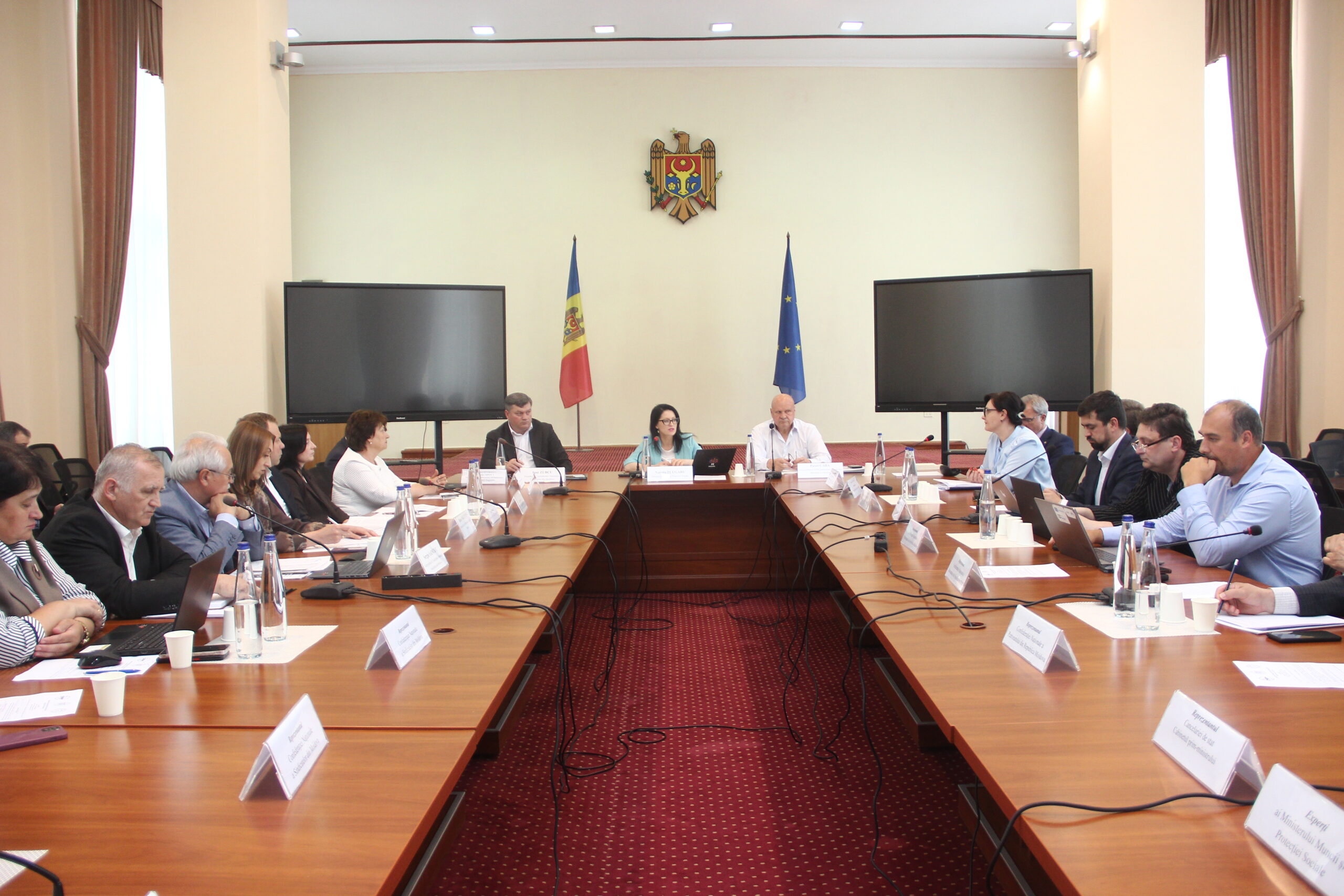
Members of the National Commission for Consultations and Collective Bargaining (CNCNC) met on May 25, 2026, to examine several current issues related to the labour market and the social protection of employees. The agenda included topics concerning the review of the minimum wage level and the drafting of a new remuneration law, the extension of financial support mechanisms for young specialists, as well as the implementation of legal provisions regarding unused annual leave.
One of the main topics discussed during the meeting concerned the reform of the remuneration system. Representatives of the Ministry of Finance announced that the concept note had been approved and that the authorities aim for the new draft law to be adopted by Parliament by September 1, 2026. In this context, the social partners also discussed the need to adjust the national minimum wage for the coming year.
Representatives of the National Trade Union Confederation of Moldova (CNSM) stressed the importance of including clear and effective mechanisms in the draft law to ensure the practical implementation of the provisions set out in the concept. Trade union representatives also reiterated the need to increase the national minimum wage so that it reaches 50% of the average wage, in line with the provisions of the European Union Directive on adequate minimum wages.
Another important issue examined during the meeting concerned measures to stimulate the employment and retention of young specialists in the fields of national defence, state security, and public order. In this regard, amendments to the legislation were proposed in order to grant a one-time allowance to young graduates in these sectors during their first years of employment, similar to the benefits already provided to employees in education, healthcare, and social assistance.
Trade union representatives also emphasized the need to extend support mechanisms to other areas of the public sector facing staff shortages. CNSM additionally advocates for the expansion of motivation programmes within the real sector of the economy in order to attract and retain young specialists in the country’s strategic sectors. The subject will be further analysed by the members of the tripartite commission.
The meeting also addressed difficulties encountered in the implementation of the new legal provisions concerning unused annual leave. Representatives of employers’ organizations pointed out several ambiguities regarding the deadline for using accumulated leave, the conditions under which leave may be carried over, and the application of the rules in special situations, including the suspension of the individual employment contract or childcare leave. Certain inconsistencies between the provisions of the Labour Code and the amendments introduced by Law No. 47/2024 were also highlighted, as they create difficulties in interpretation and practical application.
In this context, the social partners stressed the need for a uniform and clear approach to the legislation in order to prevent labour disputes and ensure respect for the rights of both employees and employers. The parties also agreed to continue consultations in order to identify balanced and effective solutions for both employees and employers.
It should be recalled that the National Commission for Consultations and Collective Bargaining is an autonomous tripartite body of public interest within the framework of social partnership, established to address labour and socio-economic issues and to promote the development of social dialogue at the national level.
The video recording of the CNCNC meeting of May 25, 2026, including the full statements of all participants, can be accessed here: https://privesc.eu/arhiva/111504/Sedinta-Comisiei-nationale-pentru-consultari-si-negocieri-colective-din-25-mai-2026