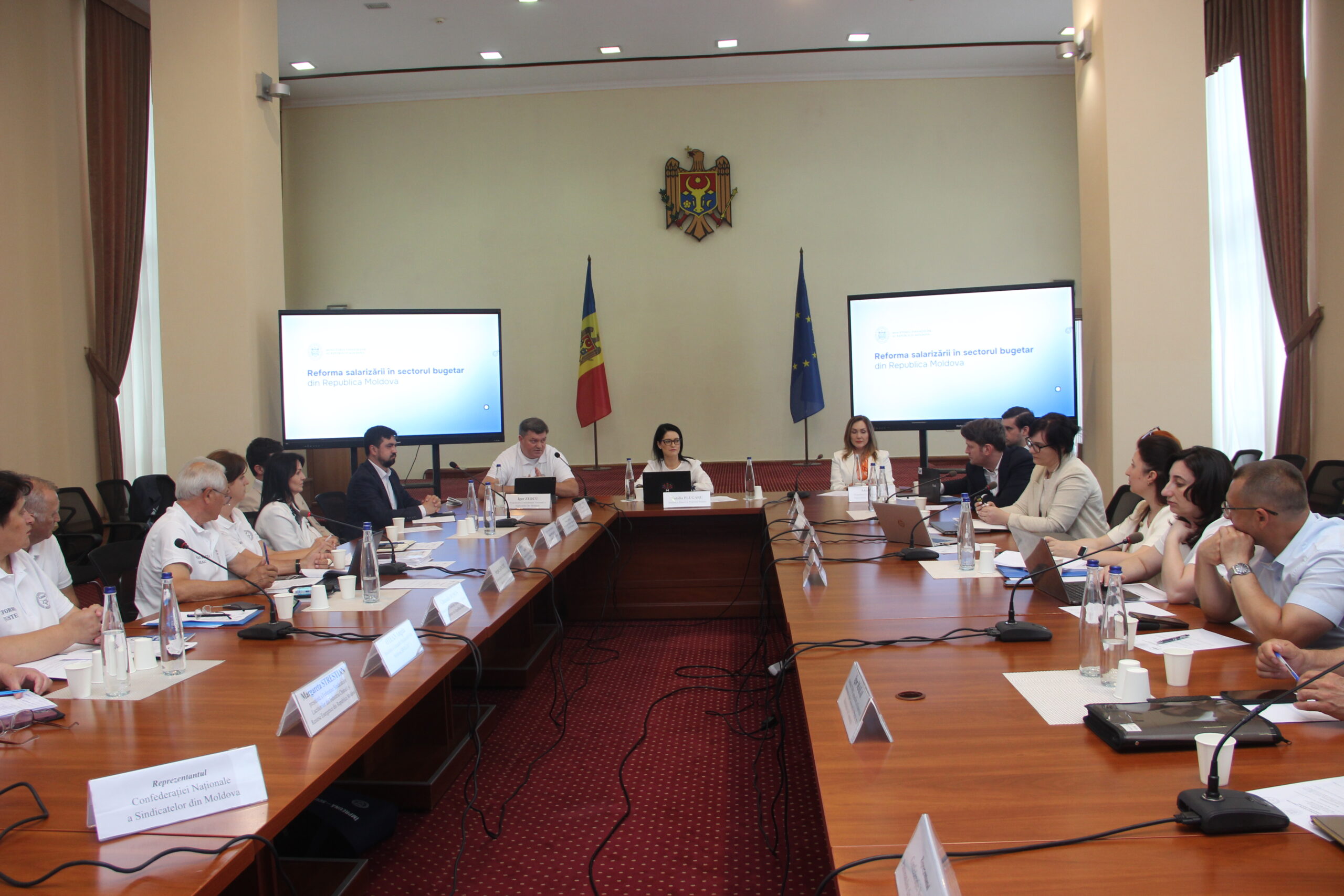
Members of the National Commission for Collective Consultations and Bargaining met in an ordinary session on 22 June 2026 to examine issues of major importance for workers and the national economy. The agenda included the draft Fiscal and Customs Policy for 2027 and the new concept for reforming the wage system.
Participants discussed the draft fiscal and customs policy, its impact on the purchasing power of the population, and the mechanism for applying the zero-tax rate to undistributed income. Representatives of the Ministry of Finance emphasized the need for a fair and sustainable tax system aligned with the Republic of Moldova’s European commitments.
The National Trade Union Confederation of Moldova (CNSM) presented a comprehensive set of proposals and objections, expressing its disagreement with measures that could lead to a reduction in workers’ real incomes and an increased tax burden on the population. Further details on the CNSM’s previously presented position are available here: https://sindicate.md/2026/06/19/cnsm-avertizeaza-reforma-fiscala-propusa-risca-sa-afecteze-veniturile-salariatilor-si-nivelul-de-trai-al-populatiei/.
CNSM considers that any fiscal reform of such magnitude must be based on genuine consultations with the social partners, thorough assessments of its economic and social impact, and effective measures to protect the population’s standard of living.
The Confederation criticized the proposal to transfer the obligation to pay state social insurance contributions from employers to employees, warning that such a change could create confusion, complicate wage negotiations, and reduce net incomes for certain categories of workers. CNSM also called for the introduction of clear and effective mechanisms to guarantee that employees’ income levels will be maintained after the new regulations enter into force.
CNSM also opposed the proposed reduction of funds allocated for one-off bonuses, annual bonuses and performance-related allowances, considering these to be important tools for motivating and retaining qualified personnel in the public sector.
The trade unions further opposed the elimination of certain tax benefits for employees and the proposed increase in the VAT rate on essential goods and services, including food products, medicines, energy resources and other basic necessities. According to the Confederation, such measures would inevitably lead to higher prices, reduced purchasing power and deeper poverty, particularly affecting low-income earners, pensioners and other vulnerable groups. CNSM advocated maintaining the existing tax and social benefits while introducing compensatory measures to protect workers.
Another important issue discussed during the meeting concerned the reform of the wage system, particularly in the public sector, through the harmonization of reference values and the integration of specific allowances into the basic salary. These measures are intended to simplify the wage system and reduce existing inequalities. In response to concerns expressed by the trade unions regarding the protection of workers’ incomes, the authorities assured participants that the implementation of the new remuneration formula would not result in a reduction of employees’ current earnings.
Trade union leaders stressed that the minimum wage and wage scales should be set at a level that guarantees a decent standard of living and reflects the actual cost of the minimum consumer basket. They also emphasized the importance of effective mechanisms to protect workers’ incomes in the context of inflation and economic fluctuations. According to the trade unions, the minimum wage should remain an effective instrument of social protection and employment promotion, particularly as inflation continues to erode the purchasing power of the population.
According to the Confederation’s assessments, wage increases for a significant number of employees are expected to be modest and may be offset by rising prices and the planned fiscal changes.
CNSM also expressed concern regarding several provisions of the draft amendments to Law No. 270/2018 on the Unified Wage System in the Budgetary Sector, which would limit the possibility of granting additional remuneration rights through collective agreements and individual employment contracts. According to the Confederation, these proposals are contrary to the principles of social dialogue and collective bargaining enshrined both in national legislation and in the conventions of the International Labour Organization (ILO) and other international instruments ratified by the Republic of Moldova.
The trade unions consider that restricting the autonomy of the social partners in negotiating employment and wage conditions may undermine the social dialogue mechanisms developed over the years and could raise concerns among international supervisory bodies regarding the Republic of Moldova’s compliance with its commitments in the fields of labour rights and social dialogue.
CNSM will continue its dialogue with public authorities and social partners to promote fair wage and fiscal policies that ensure higher incomes for the population, protect the rights of workers and trade union members, and contribute to the sustainable development of the national economy.
It should be noted that the next meeting of the National Commission for Collective Consultations and Bargaining will take place on 29 June 2026, when discussions on the draft proposals will continue, taking into account the comments and recommendations submitted by the social partners.
The video recording of the National Commission meeting held on 22 June 2026, including the full statements of all participants, is available here: https://privesc.eu/arhiva/111680/Sedinta-Comisiei-nationale-pentru-consultari-si-negocieri-colective-din-22-mai-2026.
The National Commission for Collective Consultations and Bargaining is an autonomous tripartite public-interest body of the social partnership system, established to address labour and socio-economic issues and to promote social dialogue at the national level.