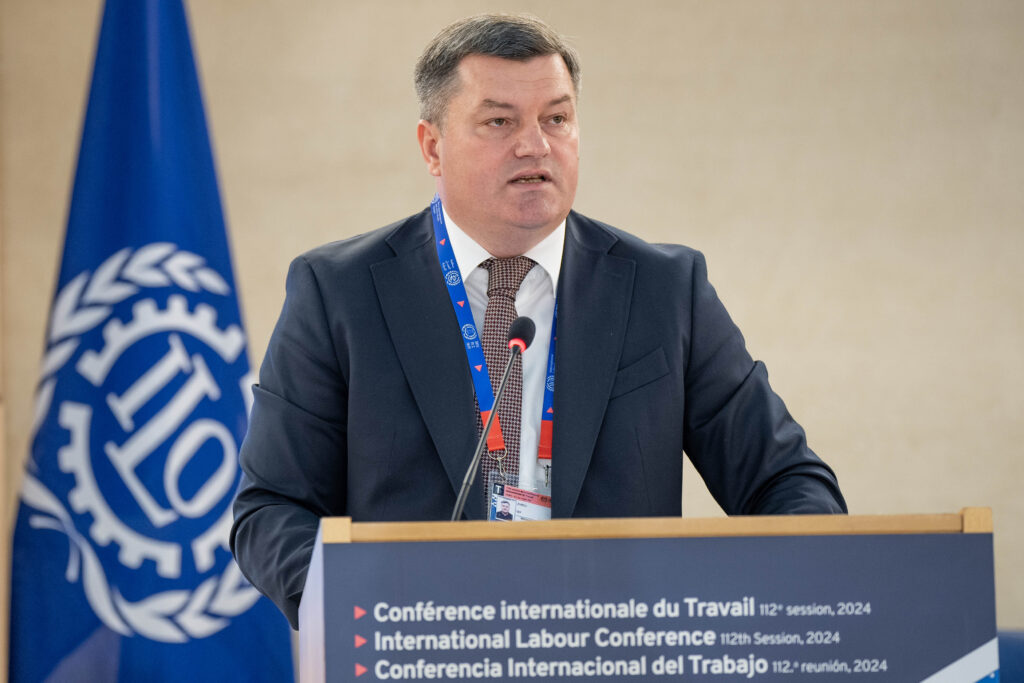
On March 31 – April 1, 2026, Chișinău is hosting the Regional Constituency meeting of the European Federation of Public Service Unions (EPSU) for South-East Europe. The event opened with an inaugural address by the President of the National Trade Union Confederation of Moldova (CNSM), Igor Zubcu, who emphasized the importance of trade union solidarity in the context of current labour market challenges.
“This meeting goes beyond the framework of a simple working session. It reflects our shared commitment to strengthening trade union cooperation at the regional level, exchanging best practices, and defining clear directions for future action,” Igor Zubcu stated at the opening of the event.
In his speech, the CNSM President presented the Confederation’s key recent achievements, including:
- setting the national minimum wage at 6,300 MDL as of January 1, 2026;
- ratification of ILO Convention No. 190 on violence and harassment in the world of work and its transposition into national legislation;
- exemption of trade unions from state registration fees (Law No. 234/2023);
- alignment of the labour inspection system with international standards.
At the same time, Igor Zubcu outlined priorities for the upcoming period: promoting a minimum wage equivalent to 50% of the average salary in the economy, expanding collective bargaining coverage to 80%, and firmly supporting the European integration path of the Republic of Moldova.
His message concluded with a call for unity and cooperation: “Only together can we effectively respond to contemporary challenges, seize opportunities, and defend the values of decent work and social justice.”
The meeting continued with contributions from Paola Panzeri, EPSU Deputy General Secretary, and Răzvan Gae, Vice-President of the Sanitas Federation Romania and President of the EPSU South-East Europe Trade Union Group. They addressed key issues for the European trade union movement, highlighting the role of unions in protecting workers’ rights, particularly in the context of increasing pressure on the public sector.
Paola Panzeri emphasized the contribution of public service unions to maintaining high standards of social protection, while Răzvan Gae pointed to region-specific challenges such as labour migration, development disparities, and the weakening of collective bargaining in some countries.
The event brings together representatives of trade union organizations from public services, healthcare, and administration across the region, including the Republic of Moldova. The two-day agenda includes key topics such as trade union recruitment and organizing, collective bargaining, trade union rights, youth engagement, equal opportunities, as well as the impact of digitalization and artificial intelligence on the labour market.
It is worth noting that six national sectoral trade union federations from the Republic of Moldova are affiliated with EPSU: the Federation of Trade Unions of Public Service Employees (SINDASP), the “Sănătatea” Trade Union Federation, the “SINDLEX” Federation, the “Sindindcomservice” Federation, the “Sindenergo” Federation, and the Federation of Trade Unions in Energy and Industry.
The European Federation of Public Service Unions brings together over 250 trade union organizations across Europe and represents approximately 8 million workers in the public services sector.