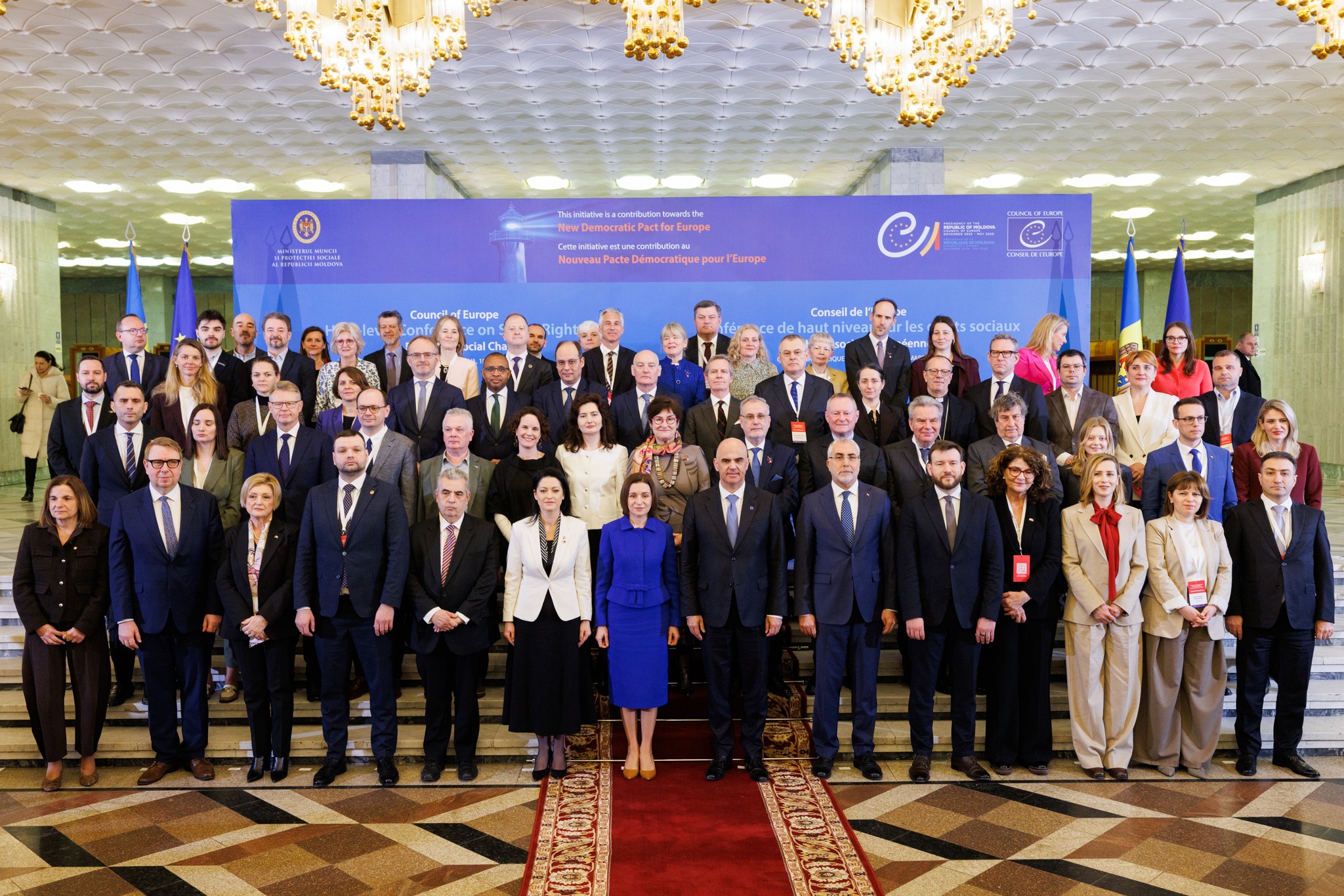
The President of the National Trade Union Confederation of Moldova (CNSM) and President of the Pan-European Regional Council of the International Trade Union Confederation, Igor Zubcu, participated on March 19 in the High-Level Conference on Social Rights – European Social Charter, held in Chișinău.
During the panel discussion titled “The Future of Work: Responses to Emerging Challenges,” Igor Zubcu emphasized that the use of artificial intelligence can create significant opportunities for the labor market, but only if properly regulated. In the absence of adequate safeguards, emerging technologies may negatively affect jobs, workers’ rights and freedoms, as well as their security and privacy.
In his intervention, the trade union leader highlighted the need to strengthen the regulatory framework at both national and international levels, including by promoting the signing and ratification of the Council of Europe Framework Convention on Artificial Intelligence—the first international legal instrument aimed at ensuring respect for human rights, democracy, and the rule of law in the context of rapid technological development.
Igor Zubcu also underlined the essential role of social dialogue in managing the impact of automation, noting that it helps prevent job losses, supports upskilling and reskilling of workers, and ensures a just transition.
Another topic addressed was algorithmic management and its use in organizing work, particularly within the platform economy. In this context, the importance of algorithmic transparency and access to relevant information was highlighted as key to protecting workers’ rights. A call was also made to support the adoption of an International Labour Organization Convention and Recommendation on platform work.
The CNSM President reiterated that the implementation of artificial intelligence in the workplace must be carried out through collective bargaining, with full respect for workers’ and trade unions’ rights, as well as the principle of human oversight. In this regard, collective bargaining remains a key instrument for ensuring a fair distribution of productivity gains.
At the same time, it was noted that, according to the ITUC Global Rights Index, violations of workers’ and trade union rights are on the rise in Europe, including restrictions on the right to strike and the intensification of anti-union practices.
In conclusion, Igor Zubcu stressed that respecting workers’ rights and strengthening social dialogue are essential conditions for democratic development. Strong trade unions, effective social partnership, and collective bargaining are the pillars of the European social model and key guarantees for a fair technological transition.