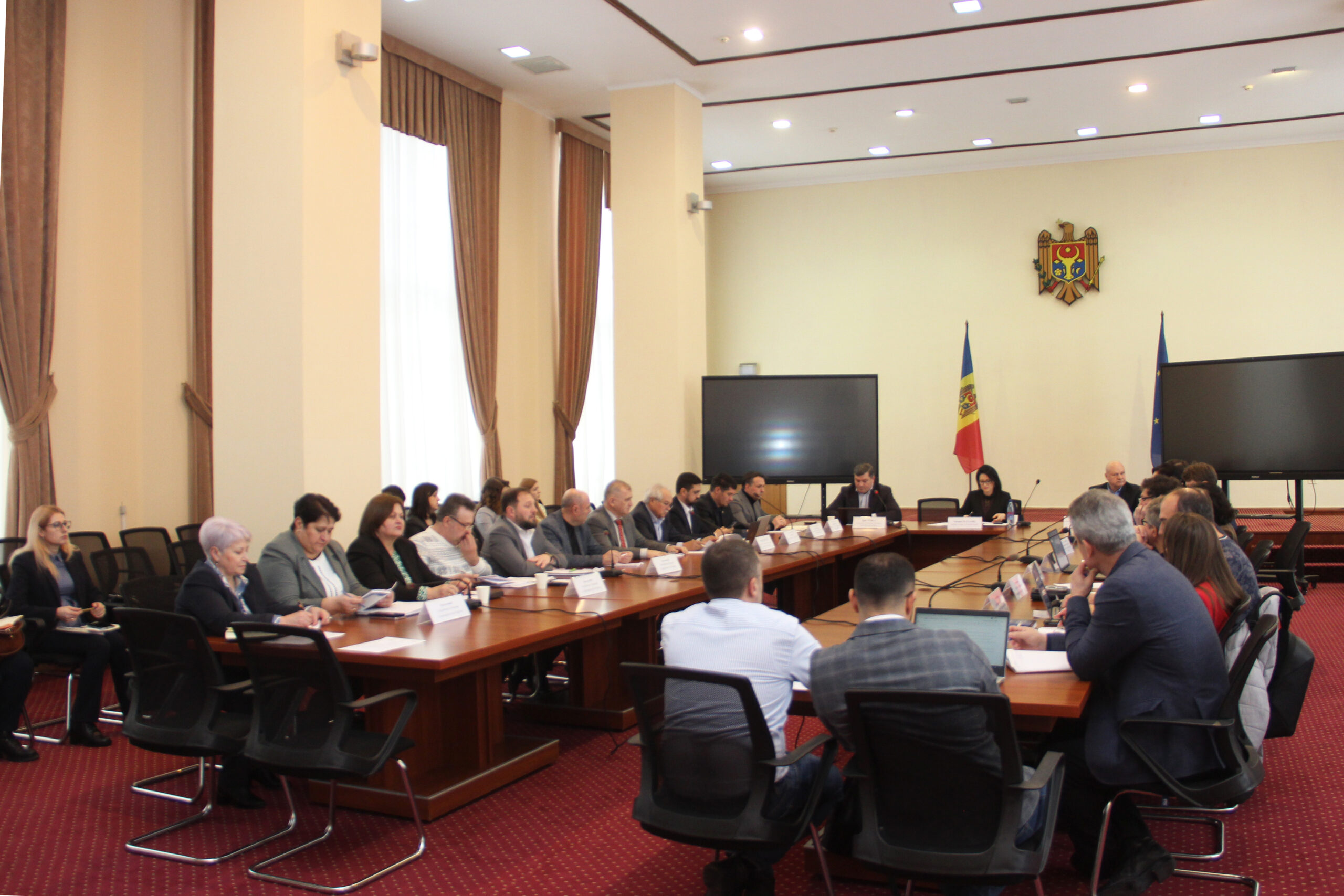
On 23 February 2026, a meeting of the National Commission for Consultations and Collective Bargaining (CNCNC) was held at the Government House. During the session, several topics of major importance for the labour sector and the strengthening of social dialogue were examined.
The first item on the agenda concerned the reconsideration of the national minimum wage, the formulation of proposals to amend the regulatory framework governing remuneration in the real sector, and the development of wage policy measures for the budgetary sector.
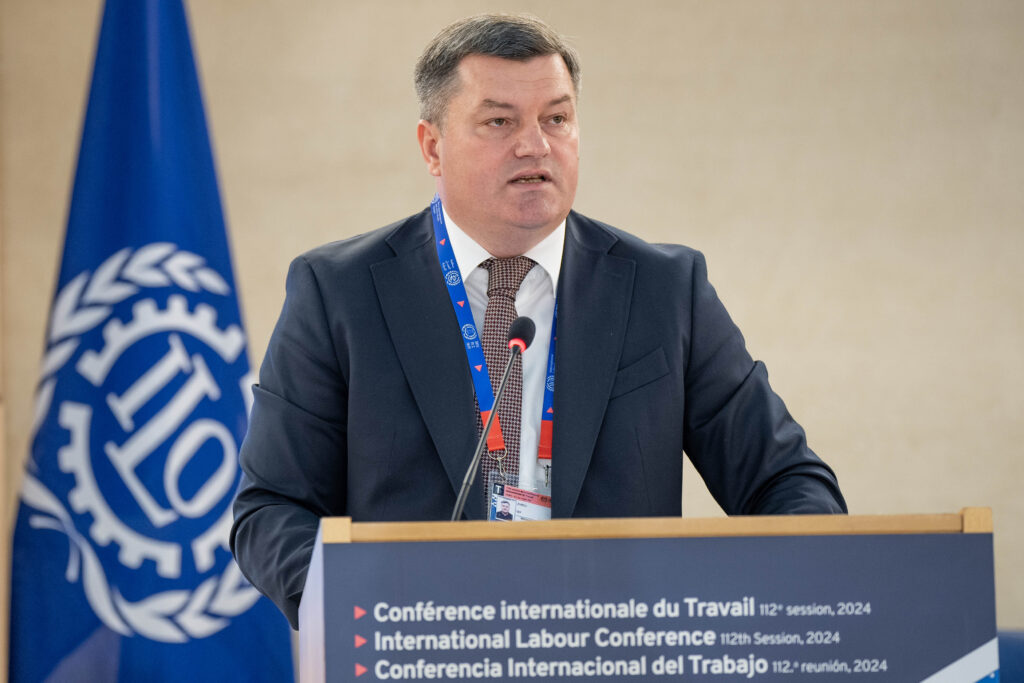
During the meeting, the President of the National Trade Union Confederation of Moldova (CNSM), Igor Zubcu, reiterated the firm position of the trade union movement regarding the need to establish a clear, transparent, and predictable framework for determining the national minimum wage.
A central topic of the agenda addressed medium-term wage policy, including the Government’s commitments to gradually increase the population’s income, with the objective of reaching a minimum wage of 10,000 lei and an average wage of 25,000 lei by the end of the current Government’s mandate.
Discussions also focused on aligning the national framework with European standards, particularly the provisions of the EU Directive on adequate minimum wages. Emphasis was placed on reducing existing discrepancies in the calculation and application of the minimum wage between the budgetary and the real sectors. Trade union representatives stressed that a unified and coherent approach is essential to ensure wage equity and social stability.
“For us, it is essential that wage policy be maintained in fair balance with economic policy. We cannot speak of sustainable development in the absence of incomes that ensure dignity and social security. We seek a minimum wage that guarantees a decent standard of living, not merely subsistence, and that protects all workers, regardless of the sector in which they are employed. Increasing incomes is the main instrument through which we can reduce social inequalities, combat in-work poverty, and discourage the informal economy,” Igor Zubcu emphasized.
The CNSM President further underlined that trade unions will continue to promote a mechanism for setting the minimum wage based on real economic indicators, genuine consultations within the framework of social dialogue, and compliance with commitments undertaken in the European integration process of the Republic of Moldova.
Representatives of the National Trade Union Confederation of Moldova presented information regarding the implementation of Government Decision No. 743/2002 on the remuneration of employees in financially autonomous entities, highlighting the need for a comprehensive review of salary scales and position-related pay ranges in accordance with paragraph 2 (second indent) of the cited normative act.
At the same time, proposals were reiterated regarding:
- the removal of the term “maximum” from the table of complexity coefficients to prevent misinterpretations;
- the increase of complexity coefficients for certain strategic sectors, including the energy sector, activities related to air transport, and financially autonomous units within branches of the budgetary sphere.
Following the debates, the Commission took note of the information presented and decided that the Ministry of Labour and Social Protection would convene the technical working group to examine the proposals for amending Government Decision No. 743/2002 and report on progress at the next meeting.
Another important topic concerned the implementation of the Integrated Automated System “Electronic Register of Employees” for the real sector of the economy. According to CNSM, the introduction of an electronic employee register in the Republic of Moldova represents an essential step toward modernizing the labour market and reducing undeclared work, which continues to seriously affect the economy, public revenues, and workers’ rights.
The trade union side emphasized the importance of implementing an integrated electronic system enabling real-time registration of individual employment contracts, reducing undeclared work, and enhancing the effectiveness of inspections carried out by the State Labour Inspectorate. The need to register employees before their first working day and to ensure interoperability with other reporting platforms (State Tax Service, National Social Insurance House, etc.) was also highlighted.
For its part, the National Confederation of Employers of the Republic of Moldova drew attention to the administrative burden generated by the current fragmentation of reporting (IPC21, IRM19, M1, M3, FORPRO/AM), advocating for:
- harmonization of indicators among institutions;
- interoperability of systems;
- simplification and consolidation of thematic reporting forms.
The issue of identifying an agreed solution regarding the implementation of the Electronic Register in the real sector will be further examined by the social partners.
During the meeting, the proposed amendments to Contravention Code No. 218/2008 aimed at establishing clear sanctions for anti-union interference were also examined.
Following a complaint submitted by CNSM against the Government of the Republic of Moldova, the Committee on Freedom of Association of the International Labour Organization (ILO) examined Case No. 3483 (Republic of Moldova), concerning insufficient protection against acts of anti-union discrimination and interference in the activities of trade union organizations.
CNSM had informed the ILO about serious interference in trade union activities by the administration of the Public Medical and Sanitary Institution National Centre for Pre-Hospital Emergency Medical Assistance, which led to the dismantling of the existing union at the unit and the creation of a new union under the direct control of the institution’s administration.
The ILO Committee on Freedom of Association requested the Government of the Republic of Moldova to take the necessary measures to ensure that specific allegations of anti-union discrimination against members and leaders of the primary trade union are examined promptly, so that the necessary remedies, where appropriate, are genuinely effective.
During the CNCNC meeting, it was noted that the draft amendment to Article 61 of the Contravention Code provides for the introduction of explicit sanctions against interference in trade union activities and aims to safeguard trade union freedom.
The Commission requested the Ministry of Justice to expedite the promotion of the draft normative act amending Contravention Code No. 218/2008, in the context of international commitments regarding the respect for the right to organize and to bargain collectively.
The meeting also addressed the issue concerning the non-recognition of certain clauses of the collective labour agreement of JSC “Drumuri Criuleni” by representatives of the State Financial Control Inspectorate (ICFS), information on this matter being presented by the Federation of Transport Workers, Road Workers and Employees on Online Platforms of the Republic of Moldova.
According to the Federation, ICFS representatives reportedly contested the lawful application of a seniority allowance, although this allowance is clearly stipulated in collectively negotiated acts (the National Branch Collective Agreement for 2020–2025). The Federation considers that ICFS exceeded its legal competences, interfered abusively in the field of collective bargaining, and created a dangerous precedent whereby administrative bodies may invalidate collectively negotiated rights.
In connection with this matter, the Commission decided to convene a joint meeting between the Ministry of Labour and Social Protection, trade union representatives, and ICFS in order to identify a solution and ensure respect for rights negotiated through collective labour agreements.
Through the decisions adopted, the CNCNC reconfirmed the importance of tripartite social dialogue and the parties’ commitment to strengthening the regulatory framework in the labour field, protecting employees’ rights, and ensuring a fair and predictable climate for social partners.
The video recording of the CNCNC meeting of 23 February 2026 can be accessed at: