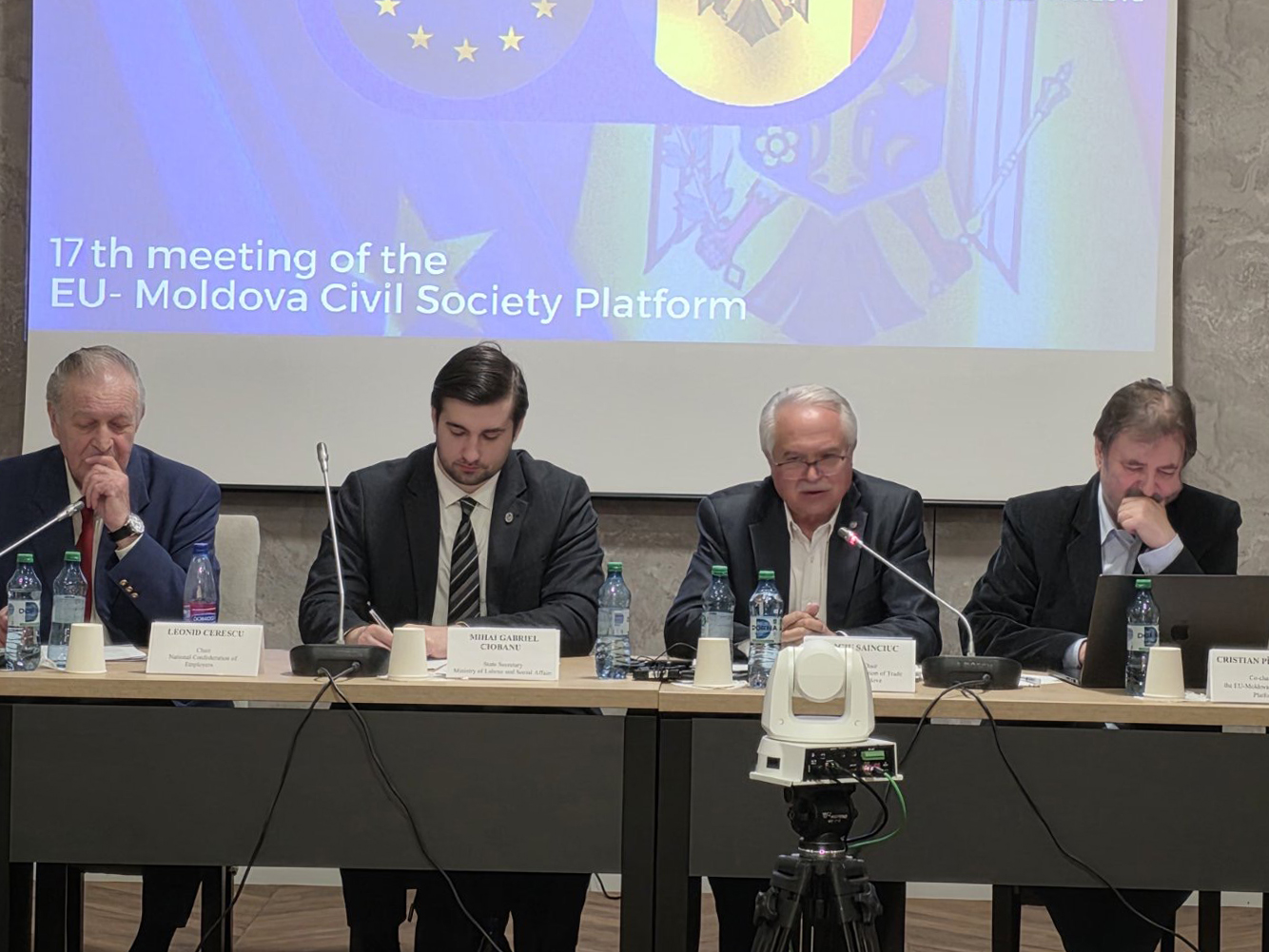
At the 17th meeting of the EU–Republic of Moldova Civil Society Platform, held in Chișinău on April 24, Platform members reviewed the progress achieved in the European integration process and emphasized the need to accelerate the next stages of accession negotiations.
Representatives of the National Trade Union Confederation of Moldova (CNSM) took part in the meeting, presenting a set of proposals in the fields of labour and social protection.
During the opening session, the President of the European Economic and Social Committee, Séamus Boland, highlighted the strategic importance of the Republic of Moldova in the EU enlargement process, as well as the essential role of civil society in supporting reforms.
In the final declaration, participants called for the official opening, without delay, of negotiations on the fundamental chapters, in light of Moldova’s progress and its commitments at the European level. They also stressed the need for meaningful involvement of civil society in decision-making processes, as well as for strengthening administrative capacity and public consultation mechanisms, including in the reform of local public administration.
Particular emphasis was placed on trade union proposals in the areas of labour legislation and the labour market. CNSM advocated for strengthening the legal framework for social partnership, in order to make social dialogue at national level more effective and inclusive.
With regard to wages, trade unions called for improving the legal framework governing remuneration in the public sector, as well as for establishing a predictable, data-driven and consultative mechanism for the periodic review of the minimum wage, at least once a year.
They also called for gradual alignment with European standards on adequate minimum wages, including through the promotion of collective bargaining. Given that collective bargaining coverage remains well below the 80% benchmark, trade unions proposed the development of concrete measures to expand it, in consultation with social partners.
Trade union representatives also emphasized the need to strengthen the capacities of the National Employment Agency and the State Labour Inspectorate in order to ensure the effective implementation of European legislation in the fields of employment and worker protection.
Another priority highlighted was the fight against undeclared work, particularly in sectors such as agriculture and construction. In this regard, trade unions called for intensified inspections, improved employee awareness, and more effective use of existing reporting mechanisms.
They also stressed the need to strengthen the capacity of public institutions to prevent workplace accidents and occupational diseases, ensuring that working conditions fully comply with European occupational safety and health standards.
The declaration also includes a firm call against excessive flexibilization of labour legislation to the detriment of workers’ rights, underlining that any reform must comply with the protection standards set out, including those provided for in the EU–Moldova Association Agreement.
The meeting reaffirmed the role of the EU–Moldova Civil Society Platform as a key mechanism for dialogue between civil society in the European Union and the Republic of Moldova, supporting the implementation of the Association Agreement and advancing the country’s EU accession process.
The final declaration of the 17th meeting of the EU–Moldova Civil Society Platform will be published on the website: https://euromonitor.md/ro.