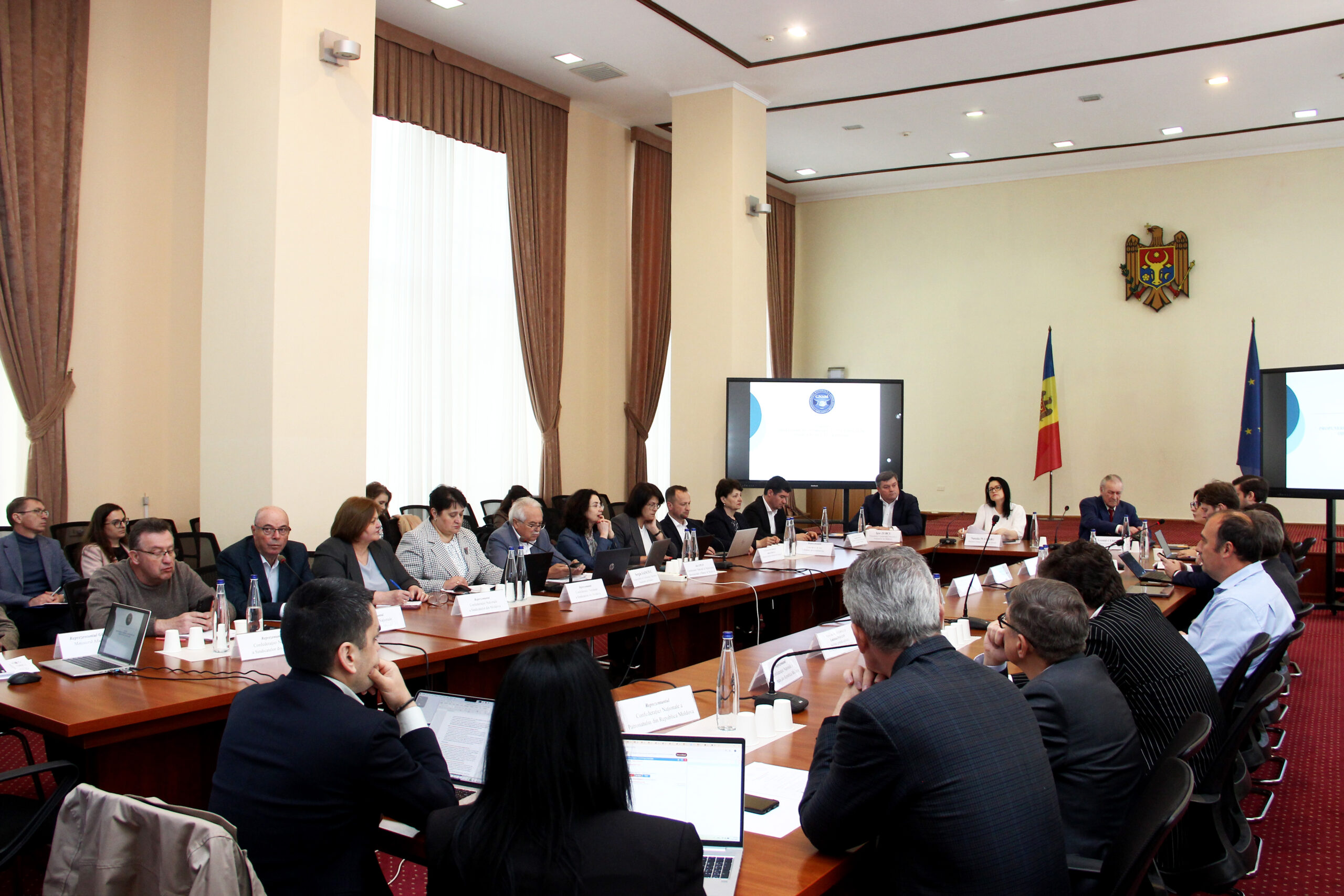
During the meeting of the National Commission for Consultations and Collective Bargaining (CNCNC), held on Wednesday, April 22, several topics of major importance for the labour and social protection sectors were examined. The agenda included the review of the national minimum wage and the development of wage policy measures for the public sector.
In the context of reviewing the minimum wage and developing wage policies for the public sector, representatives of the Ministry of Finance presented updates on actions carried out within the interministerial consultation platform.
Representatives of the National Trade Union Confederation of Moldova (CNSM) reiterated the need for predictability in setting the minimum wage for 2027, calling for the implementation of European standards whereby the minimum wage should represent 50% of the forecast average wage. They also emphasized the need to increase salaries in the public sector, including in education, starting from September 1 this year, in line with previously assumed commitments.
In turn, Natalia Plugaru, Minister of Labour and Social Protection, reaffirmed the Government’s commitment to increase the minimum wage to 10,000 lei over the next four years. In May, social partners will convene in a working group to analyze the legal framework governing wages.
At the request of the National Association of ICT Companies, through the National Confederation of Employers of the Republic of Moldova, the agenda also included the issue of converting annual leave from calendar days into working days. The Association proposed a formula of 20 working days for a standard five-day workweek, a model applied in several European Union countries.
This topic generated intense discussions. Representatives of the business community and employers’ organizations, including those from the IT sector, argued that such a change would bring greater clarity and reduce existing discrepancies.
However, the proposal was firmly rejected by CNSM representatives, who warned that changing the calculation method could lead to reduced employee income in cases where leave is taken in parts. They also referred to the provisions of the Revised European Social Charter, which guarantees at least four full weeks of annual leave. The issue will be further examined.
The meeting also addressed proposed amendments to Law No. 1544/1993 on pension provision for military personnel and individuals from command staff and internal affairs bodies, specifically regarding the re-examination of pensions once every two years for those who continue working after becoming eligible for retirement. Information and proposals were presented by Angela Otean, President of the Trade Union Federation “SINDLEX”.
Trade union representatives from law enforcement institutions called for correcting an existing inequality in the pension system for military personnel and individuals with special status through legislative amendments.
- introduction of the right to pension re-examination for beneficiaries under Law No. 1544/1993, similar to the system applicable to public pension beneficiaries (Law No. 156/1998);
- ensuring equal treatment across different categories of pensioners, given that all contribute to the social security system;
- recognition of employment periods completed after retirement, allowing working pensioners to benefit from recalculated pensions;
- elimination of legislative discrimination affecting military personnel and public officials with special status;
- strengthening social protection for these professional categories, taking into account the specific nature of their work (risks, restrictions, responsibilities).
The “SINDLEX” Federation requested support for this initiative within the framework of tripartite dialogue, aiming to establish a fair, transparent, and motivating social protection system.
Additionally, commission members reviewed the stages required for transposing several European directives included in the National Accession Plan. These regulations mainly address platform work, equal treatment, and increased transparency in the labour market.
In this context, a draft law amending several normative acts in the fields of labour relations, occupational safety and health, and equal treatment (single number 181/MMPS/2026) was examined. The document aims to transpose provisions of several EU directives — 89/391/EEC, 91/383/EEC, 92/85/EEC, 2000/43/EC, 2000/78/EC, 2002/14/EC, 2008/104/EC, and 2014/67/EU — and to establish the framework for implementing Regulation (EU) 2019/1149.
It should be noted that the National Commission for Consultations and Collective Bargaining is an autonomous tripartite public-interest body established to address labour and socio-economic issues and to develop social partnership at the national level.
The video recording of the CNCNC meeting of April 22, 2026, including all participants’ interventions, is available on the CNSM Facebook page: https://www.facebook.com/sindicate.md.