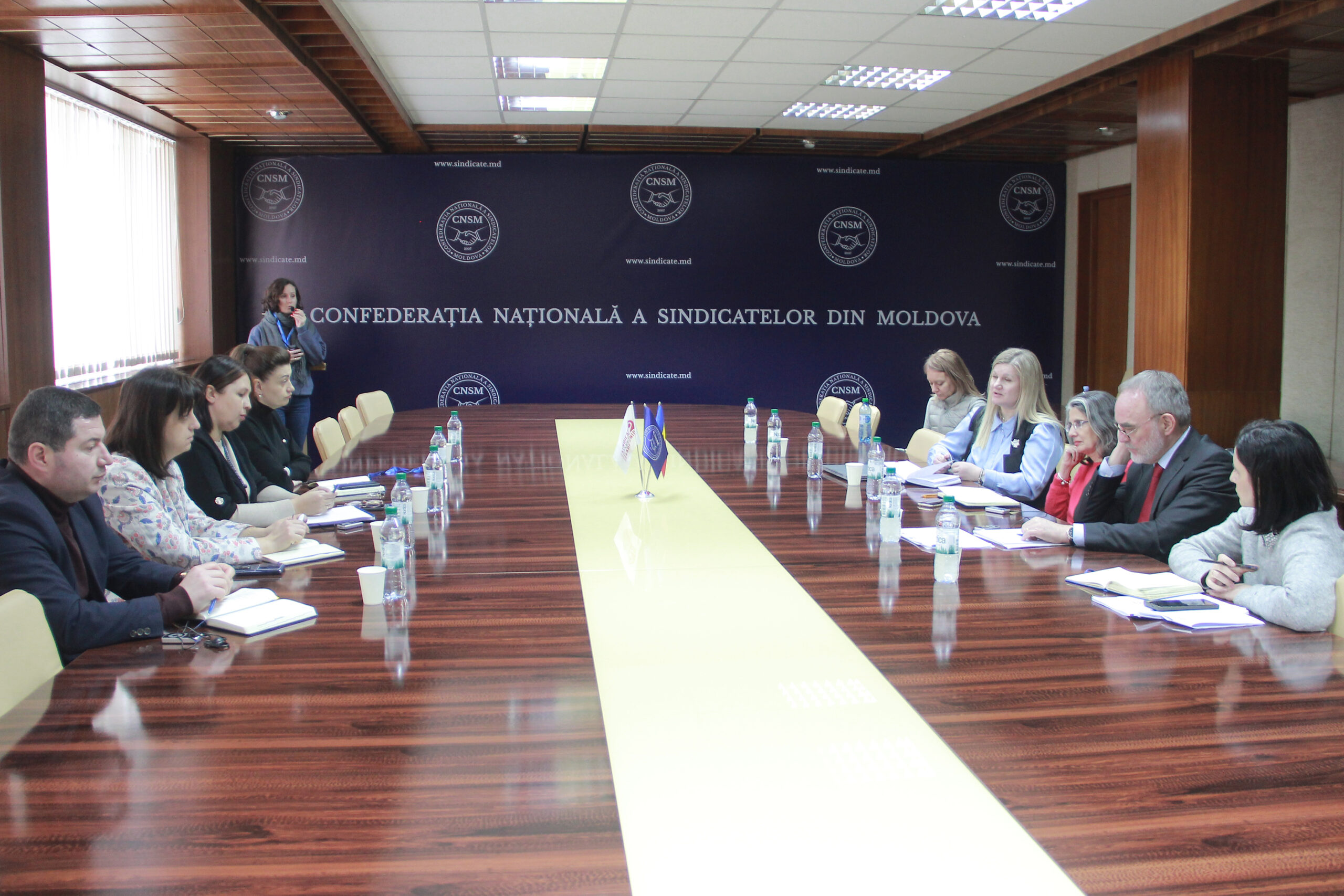
Representatives of the National Trade Union Confederation of Moldova (CNSM) held a meeting on Wednesday, 18 February, with specialists from the International Labour Organization (ILO) – Markus Ruck, Social Protection Specialist at the ILO Decent Work Technical Support Team and Country Office for Central and Eastern Europe, and Maria José Chamorro, Gender Equality and Formalization Specialist from the same office.
The dialogue focused on the need to strengthen social protection for domestic and care workers in the Republic of Moldova, in the context of promoting decent work, formalizing employment relationships, and aligning national legislation with international standards.
Lilia Franț, Vice-President of CNSM, expressed appreciation to the International Labour Organization for its support in the process of implementing and promoting ILO Convention No. 190 and ILO Convention No. 156, emphasizing the importance of the technical assistance and expertise provided in harmonizing the national regulatory framework with international standards.
The CNSM Vice-President noted that the ILO’s continued support contributes to strengthening trade union capacities, developing social partnership, promoting a safe and equitable working environment—including in terms of equal pay between women and men—and ensuring respect for the fundamental rights of employees in the Republic of Moldova.
A central topic of the dialogue was the ratification of ILO Convention No. 189 concerning domestic workers, which establishes clear standards regarding equal treatment between domestic workers and other employees, including with respect to normal working hours, overtime compensation, rest periods, paid annual leave, and the guarantee of a minimum wage.
CNSM emphasized that although national legislation—including provisions of the Labour Code governing individual employment contracts concluded between natural persons—provides certain regulations, significant gaps persist in practice. There is no clearly regulated mechanism for withholding and paying income tax, social insurance contributions, and mandatory health insurance premiums in employment relationships between natural persons.
Furthermore, as of 1 January 2026, Law No. 228/2025 on the independent economic activity of natural persons entered into force. This law allows for the registration of independent service providers and the payment of a single 15% tax; however, it does not regulate essential aspects such as working hours, overtime pay, weekly rest, or the guarantee of a minimum wage.
During the discussions, CNSM reiterated the proposal previously submitted at the meeting of the National Commission for Consultations and Collective Bargaining regarding the initiation of the ratification process for ILO Convention No. 189 and the urgent development of the necessary mechanisms for its implementation.
The meeting also addressed examples of good practices developed within the campaign “Be the Voice of Equity in the Workplace!”, in the context of promoting ILO Convention No. 156. These initiatives materialized in a series of trade union actions implemented at the local level across various districts, enterprises, and sectors, aimed at supporting workers with family responsibilities.
Another topic discussed concerned the Model Regulation on measures to prevent and combat sexual harassment in the workplace, developed by CNSM in cooperation with the Women’s Law Center. The Regulation provides a clear framework for the prevention, reporting, and examination of harassment cases. The need for its effective implementation at the unit level was emphasized, including through the incorporation of its provisions into internal regulations and collective labour agreements, in order to ensure a safe working environment.
CNSM reaffirms its willingness to actively engage in the process of aligning the national regulatory framework with international standards and to contribute to the creation of an equitable system that guarantees decent work, social protection, and respect for fundamental rights for all workers, including those in the domestic sector.